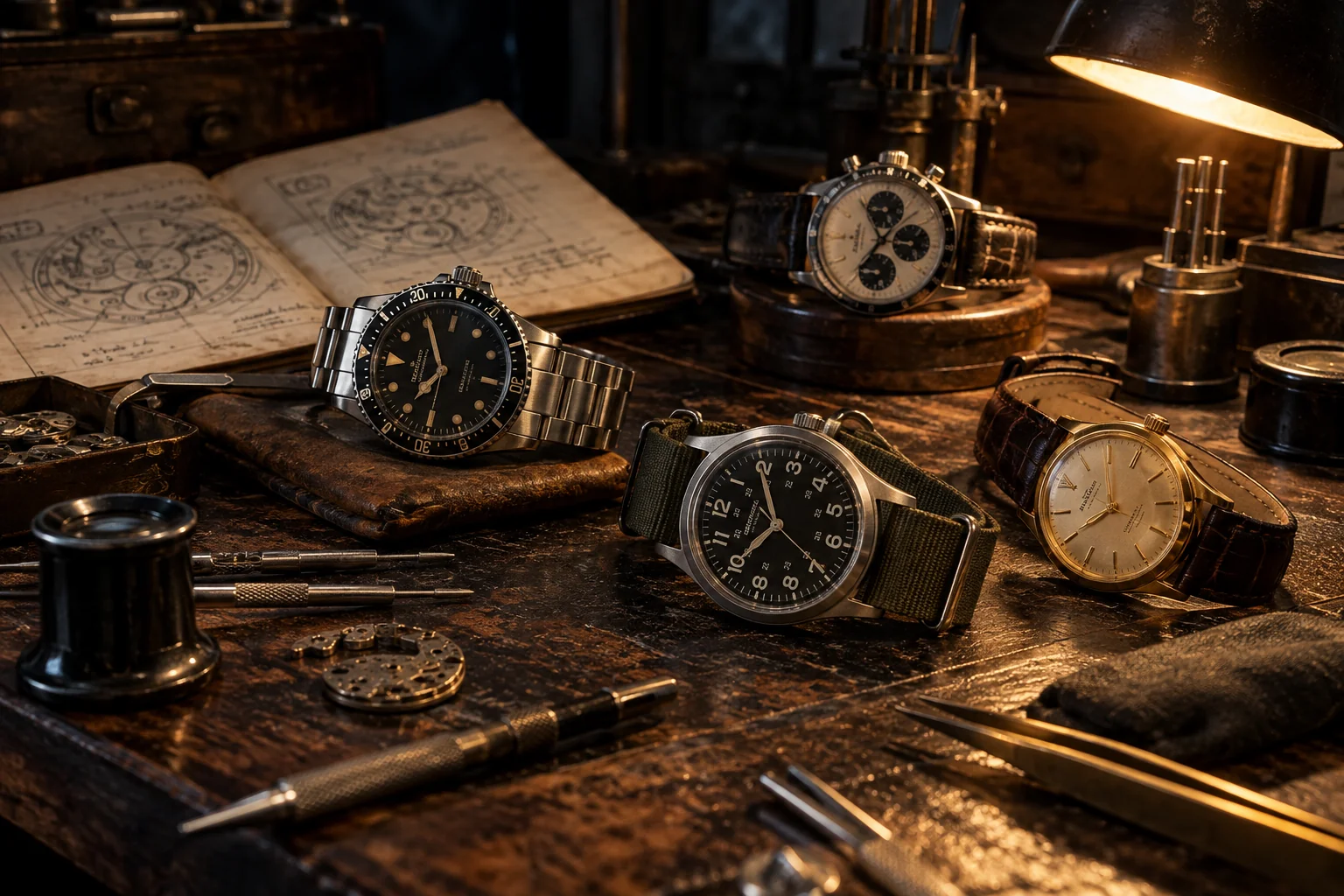
A worn watch is a small argument against the disposable world. It is not a perfect argument. Mechanical movements require service, parts are lost, water finds its way through bad seals, and owners can be extraordinarily inventive in the damage they inflict. Still, the object persists. Its persistence invites a question: why do we repair certain things rather than replace them?
Viktor believes the answer is rarely financial. If the parts, labor, and uncertainty cost more than a new watch, the rational calculation is clear. And yet people bring him modest watches whose resale value would not pay for a decent lunch. Sometimes they belong to fathers or grandparents. Sometimes they commemorate an ordinary Tuesday that became important only years later.
Usefulness is only a beginning
A watch need not be accurate to the second to be useful. It must be sufficiently reliable for the life its owner intends to lead. The same can be said of old cars, fountain pens, sailing boats, and the enormous collection of imperfect tools that people pass from hand to hand.
The modern instinct is to optimize: make the dial brighter, the case shinier, the crystal flawless, the movement faster. But restoration is not the same as correction. A polished case can lose its edges. A replacement dial can erase decades of texture. A new part, however technically superior, can reduce the evidence that made an object interesting in the first place.
To repair something properly, one must first decide what deserves to remain unchanged. This is a question of judgment before it is a question of dexterity.
“A machine may be honest about what happened to it. We should extend it the same courtesy.” V. Chas, bench notebook
The impossibility of keeping time
Consider the phrase keeping time. A watch keeps nothing. It measures recurring motion and offers us a convenient fiction: that our lives can be divided into equal, numbered pieces. The seconds are equal. Our experience of them is not. Ten minutes waiting for a late train feel unlike ten minutes driving with someone you love.
There is a difference between measured duration and lived duration. The instrument handles the first beautifully. The second remains our responsibility. We ask the watch how long. We ask ourselves what it meant.
That is why old watches sometimes become more valuable to their owners as their mechanical performance declines. What they remember cannot be measured on a timing machine. Their importance is not a function of beat error.
A practical philosophy
Sentiment, however, does not excuse sloppy work. Viktor insists on documentation, clear condition statements, photographs of work performed, and an honest account of what was changed. He would rather return a watch running a little imperfectly with an explanation than conceal an irreversible alteration behind a beautiful photograph.
A damaged component should be repaired where sensible, replaced where necessary, and described without theater. When the decision is difficult, the owner should be invited into it. Conservation is not achieved by keeping secrets from the person paying the bill.
This is mechanical mercy: neither worshipping an object nor treating it as disposable. Caring enough to know what can be saved; being humble enough to admit what cannot.
At the end of a day's work Viktor closes his loupe, covers the instruments, and winds a modest watch on a faded strap. It makes no argument for itself. It simply continues. Often that is sufficient.